



 2025年10月21日 13:22 發布
編輯:Editor

Sum Wu
Registered Chinese Medicine Practitioner
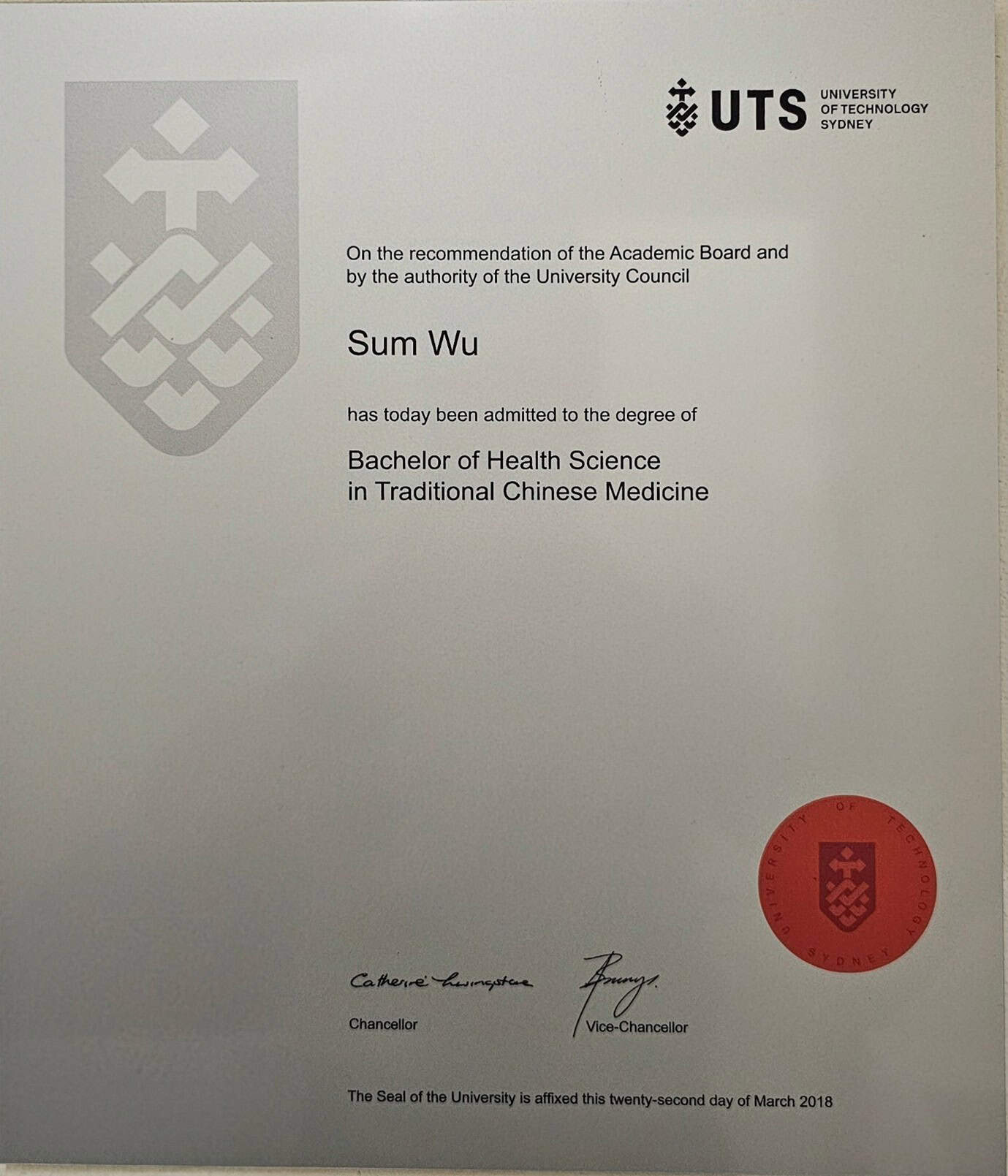
Bachelor of Health Science in Traditional Chinese Medicine (UTS)
Bachelor of Science Majoring in Psychology (UOW)
Director of Hurstville Chinese Herbs Centre
Vice Dean of College of Traditional Chinese Medicine Orthopedics Australia
Specialising in pain management and mental wellbeing through Tradition Chinese medicine in combination with modern science in mental health, dieting and nutrition.
吳宇琛,澳大利亞政府注册中醫師、針灸師,五龍崗大學心理學學士、悉尼科技大學中醫系學士,澳大利亞松軒中醫藥中心主任醫師,澳大利亞中醫骨傷專科學院副院長。
擅長用傳統針灸理傷手法和中藥治療各種新舊損傷痛症,特別採用中醫中藥和現代心理學、營養學相結合調理治療各種慢性病和亞健康。

Neurological and psychiatric disorders, ranging from anxiety and depression to Alzheimer’s disease and stroke-related impairments, are leading causes of disability worldwide. Despite advances in pharmaceuticals and psychotherapy, many patients experience incomplete relief or side effects, prompting interest in complementary approaches. Traditional Chinese Medicine (TCM), with its 2,000-year history and holistic philosophy, has become a subject of growing scientific investigation for its potential role in mental and neurological health.
神經和精神疾病從焦慮、抑鬱到阿爾茨海默病和中風後功能障礙是全球致殘的主要原因。儘管藥物和心理治療取得了進展,但許多患者仍然得不到完全緩解,或因副作用而受限,這促使人們對補充療法產生興趣。具有兩千年歷史和整體觀的傳統中醫(TCM),因其在心理與神經健康方面的潜在作用,正成為科學研究的熱點。
TCM conceptualizes health as the dynamic balance of Qi, Yin and Yang, and the harmony of organ systems. Unlike Western biomedicine, which tends to localize mental illness in brain chemistry or structure, TCM interprets conditions like anxiety, depression, or cognitive decline as systemic disharmonies. For instance, “Liver Qi stagnation” may manifest as irritability or depression, “Heart Yin deficiency” as insomnia or restlessness, and “Kidney deficiency” as poor memory or fearfulness. Treatments aim not just to relieve symptoms but to restore systemic balance and resilience.
中醫將健康視為氣、陰陽及臟腑系統之間的動態平衡。與傾向於將精神疾病歸因於大腦化學或結構异常的西醫不同,中醫將焦慮、抑鬱或認知退化等視為系統性失衡。例如,“肝氣鬱結”可表現為易怒或抑鬱,“心陰不足”表現為失眠或心神不寧,“腎虛”則可能導致記憶减退或恐懼。治療目標不僅是緩解症狀,更在於恢復整體平衡與韌性。
Acupuncture is one of the most researched TCM modalities in mental health. Neuroimaging and biochemical studies suggest it modulates brain networks and neurotransmitter systems. Clinical findings include:
針灸是研究心理健康領域最多的中醫療法之一。神經影像學和生化研究表明,針灸能够調節腦網絡和神經遞質系統。臨床發現包括:
These findings suggest acupuncture exerts both local and systemic effects on the nervous system, bridging traditional theory with measurable biological mechanisms.
這些發現提示,針灸對神經系統既有局部作用,也有全身作用,架起了傳統理論與可量測生物機制之間的橋樑。
Chinese herbal formulas are another focus of modern research. Their multi-compound, multi-target nature aligns with the complexity of neurological and psychiatric disorders.
中藥複方是現代研究的另一重點。其多成分、多靶點的特性契合神經與精神疾病的複雜性。
Ongoing studies are attempting to isolate active compounds, such as flavonoids and saponins, to clarify mechanisms and develop standardized formulations.
正在進行的研究試圖分離出活性成分如黃酮類和皂苷類,以闡明機制並開發標準化製劑。
Tai Chi and Qigong, integral to TCM’s mind-body approach, combine movement, breathing, and meditative focus. Clinical trials report improvements in executive function, working memory, and stress reduction. Neuroimaging suggests these practices may enhance connectivity in brain networks associated with attention and memory, while physiological studies show reductions in cortisol and improvements in heart-rate variability.
太極和氣功作為中醫身心結合的重要組成,融合了運動、呼吸和冥想專注。臨床試驗證明,它們能够改善執行功能、工作記憶並減輕壓力。神經影像學研究提示,這些練習可能增强與注意和記憶相關的腦網絡連接;生理學研究則顯示其可降低皮質醇水准並改善心率變異性。
Despite encouraging findings, challenges remain. Variability in herbal preparations, individualized treatment protocols, and methodological inconsistencies complicate large-scale clinical trials. Safety concerns, particularly herb-drug interactions, also require careful management. Nevertheless, the integrative potential of TCM is increasingly recognized: in China, acupuncture and herbal medicine are routinely incorporated into hospital care for stroke, depression, and insomnia, and similar trends are emerging globally.
儘管結果令人鼓舞,但仍存在挑戰。中藥製劑的差异性、個體化的治療方案以及方法學不一致,使大規模臨床試驗變得複雜。安全性問題,尤其是藥物與草藥之間的相互作用,也需要謹慎管理。儘管如此,中醫的綜合潜力正日益受到認可:在中國,針灸和中藥已被常規納入醫院對中風、抑鬱和失眠的治療,類似的趨勢也在全球範圍內逐漸出現。
TCM provides a comprehensive framework for understanding and treating neurological and mental health conditions. By combining acupuncture, herbal medicine, and mind-body practices, it offers multi-layered interventions that resonate with the complexity of brain and mental disorders. While more rigorous research is essential, the growing body of evidence suggests TCM could serve as an important complement to conventional care, expanding treatment options and improving quality of life for patients worldwide.
中醫為理解和治療神經與心理健康疾病提供了一個全面的框架。通過結合針灸、中藥以及身心療法,中醫提供了多層面的干預管道,契合腦和心理障礙的複雜性。雖然仍需更嚴格的研究,但越來越多的證據表明,中醫可以成為常規治療的重要補充,拓展治療選擇,並改善全球患者的生活質量。
如有疑問想咨詢吳宇琛中醫師,可以在微信或whatsapp搜索61 404836368,加吳宇琛中醫師微信或whatsapp,也可以發短信或致電0404836368作語音留言,吳宇琛中醫師有空就會回復。


(吳宇琛中醫師,澳大利亞政府注冊中醫師、針灸師,五龍崗大學心理學學士、悉尼科技大學中醫系學士,悉尼好思維松軒藥行主任中醫師,澳大利亞中醫骨傷專科學院副院長,本文僅供參考,具體診療應諮詢專業人士。)


 FACEBOOK
 WECHAT
 INSTAGRAM